Twelve Stones Farm

GET TO KNOW US

Welcome to the Twelve Stones Farm family! We believe it is essential for the success of any small farm in today’s world to be authentic.

We have been homesteading and hobby farming for 10+ years, raising chickens, goats, donkeys, and horses, as well as growing our own vegetables. Our desire has always been to live off the land to support a healthy and fulfilling lifestyle—we’ve made mistakes along the way, but that’s just part of the learning process. With each passing year, we’re trying to make this our reality.

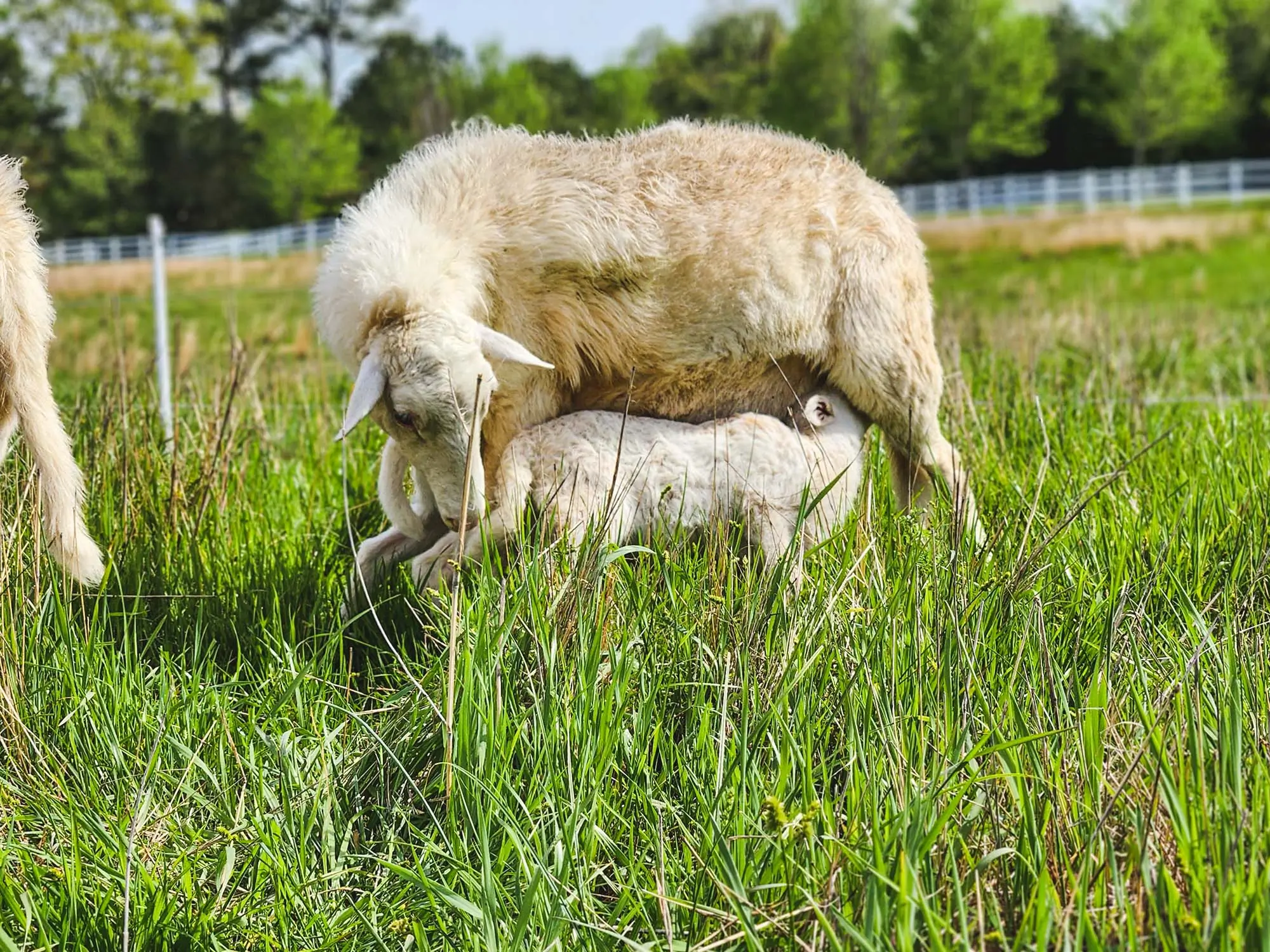
Today, we raise St. Croix / Katahdin cross hair sheep for food and breed stock. Our flock size is currently over 60 sheep, though we are culling down to our best genetics for 2026—only about 22 sheep (ewes, rams, and lambs) have made the cut.

Why do we do what we do? Like many other people around the world, we woke up to the lies of Big Agriculture. We have been taught wrongly on how to raise livestock and grow food. We’re done participating and will not be complicit in perpetuating this lie.

We want to provide our own family with natural food that is complete in nutrition and help other families do the same. That is why we raise sheep that are resistant to diseases and parasites with organic and regenerative methods for breeding stock so that we can help other homesteads and farms do what we do. It is not enough to just provide the means to do it (i.e. the animals) but it is essential to deconstruct and reconstruct our understanding of soil, how to grow food, and what food is. What we eat really does define who we are (or will be). Nutrition deprivation is the one of the primary drivers behind all of the major health crises today—we will talk about this in future blogs posts.

We want this farm to be successful not only for our own benefit, but for our friends, family, and community. We want it to be successful for the sake of our grandkids and great-grandkids—to teach them the heritage and beauty of living off the land and to provide them with the means to take care of their own families by passing on a fulfilling lifestyle with generational wealth in land and livestock, along with wisdom and knowledge that is acquired from a lifetime of experience—especially in these times of uncertainty, instability, and ever increasing dependence on government support and subsidies. We want the ability to generously provide for the needs in our communities—financially, but also with food, clothes, shelter, utilities, and transportation. We want to fulfill the biblical obligation of taking care of the needy among us to help them get on their feet and live a life without worrying about how they will make it. We pray that the Almighty God will bless the work of our hands if not for that reason alone.

OUR JOURNEY INTO REGENERATIVE AGRICULTURE

We’ve been exploring regenerative practices for a decade, but over late 2022 through 2023, our understanding was drastically changed. We knew we didn’t agree with locking animals into a small confined space only to run out of pasture and forced to feed grain and hay, while leaving a muddy, mucky mess, but we didn’t know what else to do.

After over a year of study and practice, we were convinced that you not only don’t need grain, dewormers, antibiotics, and barns, but it can actually be detrimental to animal health, welfare, and genetics.

So what initiated this radicalization? In late 2022, we discovered Greg Judy’s YouTube channel. Not long after that in January 2023, we were offered the opportunity to start a self-sufficient regenerative farm in Middle Tennessee. This not only allowed us to start implementing the regenerative practices we had been learning, but also provided us with the opportunity to attend Greg Judy’s advanced grazing schools, the latest with the brilliant Ian Mitchell Innes as the guest speaker, to truly grasp the core concepts of sustainable and profitable regenerative agriculture. Only to solidify and strengthen our understanding, we were also able to study under the brilliant Dr. Elaine Ingham’s through her Soil Food Web foundation courses. This has supplied us with a well-rounded understanding of the interaction between soil microbiology, plants, and grazing.

Unfortunately, after over a year’s worth of hard labor, raising and successfully wintering South Pole cattle and St. Croix sheep (neither of which we had ever raised) on grass with rotational grazing, supplemented with hay as necessary, on top of building 8+ miles of high-quality, state-of-the-art steel fence, our vision for the farm just didn’t align with the landowner. Though grieved by the loss of the cattle we had so tenderly cared for, we had to go our separate ways and was ultimately for the betterment of our mental health. We moved back to West Tennessee from where we came and have lived for the majority of our lives to reset and refocus. Putting all of that behind us and digging into what we have learned and practiced, we are now leasing land in our area, looking for more all the time, and have bought our own flocks of sheep, including the one we managed that came from Greg Judy’s farm, with the hopes of one day getting back into South Pole cattle as a secondary operation.
The Significance of a Name

WHY "TWELVE STONES" FARM?

Why “twelve stones?”, one might ask. We believe that there is a purpose in a name—it is a descriptor of an individual and their character. We chose Twelve Stones Farm because we believe we are called, just as every believer is, to build onto the foundational work of God through His son, Jesus Christ (whom we affectionately prefer to use the closer transliteration of his name, Yeshua), and his disciples. The motivation behind what we do and how we live our everyday lives comes from the love and devotion we have for our God. We are not forceful or aggressive with our beliefs nor do we condemn or look down upon anyone who doesn’t agree with us, but we stand firm and are convinced in what we believe and we’re not ashamed to testify to it.

The scriptural reference for our name comes from Revelation 21:19 and Ephesians 2:19-20, highlighting the significance of the faith and work of the twelve disciples, the city of God that is to come is said to have been built on twelve foundations (which are often stones, especially in ancient architecture) bearing the names of the disciples. They were monumental because of their belief and faithfulness to the Messiah, spreading the good news that he had come.

| “The wall of the city had twelve foundations bearing the names of the twelve apostles of the Lamb.” – Revelation 21:19

| 19 So then you are no longer strangers and foreigners, but you are fellow citizens with the saints, and are of God’s household, 20 having been built on the foundation of the apostles and prophets, Christ Jesus himself being the cornerstone” – Ephesians 2:19-20

Though we fall short of it, we strive our best to model our lives after the example that Yeshua and his disciples, who truly grasped living for the kingdom of heaven, have given us. We hold Yeshua not only as our savior, but also as our lord. As an obligation to the authority over you, you must obey what you are commanded. These things are not difficult, arbitrary, crazy, or illogical, but they are contrary to how we live our lives. His ways are for the benefit, protection, and provision of everyone—they establish property rights, justice, and the systems to provide for the needy.

Our Practice

HOW WE MANAGE OUR SHEEP

When you buy sheep from an auction, sure you might have paid a “good” price, but if that animal doesn’t make it or adapt to your management and you end up having to nurse it to health with trips to the vet, how much did it really cost you to buy that animal? Time and money on a worthless animal (I mean solely in the monetary sense). You will never get your money back out of her if she doesn’t make it or if you paid for multiple vet visits (this is the difference between it being a hobby and a way to sustain yourself financially). You also have no idea if you agree with the ethics and practices of the breeder you bought the animal from.

Ask us how we know.

Stay away from auctions unless you know what you are looking for. Don’t let sick animals discourage you from farming. Buy a quality animal from a reputable breeder, especially if you are just starting out. And buy an animal that matches your management style—you will save yourself tons of headaches, frustration, and even heartaches. You would rather have 5 quality animals that are thriving than a flock of 20 riddled with disease that are dropping like flies or not getting well. Start your farm off right. Raising livestock is fun and rewarding if you have the right animals and you manage them well. I talk a little bit about this in our free e-book with 11 questions to ask the seller. Sign up here and get your copy!

Similarly, the products you buy from a store, especially big box retailers, you have no guarantee about the quality of life that the animal had nor the ethics and practices of the producer or processing plant. Management, finish time, and processing techniques determine the quality of the meat you purchase—the flavor and tenderness.

The greatest grazing system: intensive, high-density, rotational grazing.

Our sheep are raised fully on pasture without vaccinations, antibiotics, dirty barns, or excessive deworming. There is a time and place for antibiotics and (non-chemical) dewormers, but you need consider everything holistically. It should be the exception, not the norm. We provide with fresh grass and well water daily, along with a quality mineral salt. This, along with their genetics, is what produces a lamb that is parasite-free and doesn’t need any medication, hoof trimming, or assistance with lambing. It produces a delicious, mild-tasting meat.

We layout paddocks every day using step-in posts and polybraid wire using solar-powered energizers, enabling us to graze any and everywhere on the farm. We currently run on our sheep on 100% leased land. Though a little inconvenient not being able to establish the infrastructure we want, we couldn’t raise sheep without the leases. We are looking for more all the time, so if you’re in the Henry County, TN area, reach out to us. We transform rundown pastures and hay fields into beautiful landscapes without seed or fertilizer, we can also install improvements like water and fence.

With our management practice, we take land that a cow would starve to death on and produce a beautiful, healthy, and thriving flock of sheep. We prove every day that you don’t need grain, barns, or antibiotics to raise livestock. You must select for the animals that are adapted to your climate, forage, and rainfall. Although we have been learning about regenerative farming techniques for years, we missed the piece that makes it all work—moving the animals. Something so simple, yet we missed for so long. We were blessed over this last year with the opportunities to speak with and learn under some of the greatest minds in this industry. Under Greg Judy and Ian Mitchell Innes, we learned about high-density rotational grazing and its incredible benefits and transformations. Under Dr. Elaine Ingham, we learned about the processes that are happening within the soil that are a result of our management—a key piece missing in conventional agriculture, the Soil Food Web.

Problematic and illness-prone animals should be culled, not passing down bad genetics and behavior. As we progress further down the line and begin recuperating our investment, we will be much stricter with our culling—ensuring that only the toughest, strongest, and highest quality of animals with good genetics are grown on our farm—keeping our flocks free from the deadly jaws of diseases and parasites.

Get in touch

PASTURE-RAISED SHEEP

PHONE

(731)-200-5260

LOCATION

Henry County, TN

EMAIL

office@twelvestones.farm

Leave us a message

Message Us Form
Scroll to Top

Get In Touch!

Message Us Form

Subscribe To Receive Our FREE E-BOOK

AND STAY UP TO DATE WITH OUR FARM

Receive a detailed guide to basic infrastructure for starting your OWN sheep farm!